
Tuesday, December 07, 2010








Monday, December 06, 2010
On Exponential Art, the number 59, Vermillion,
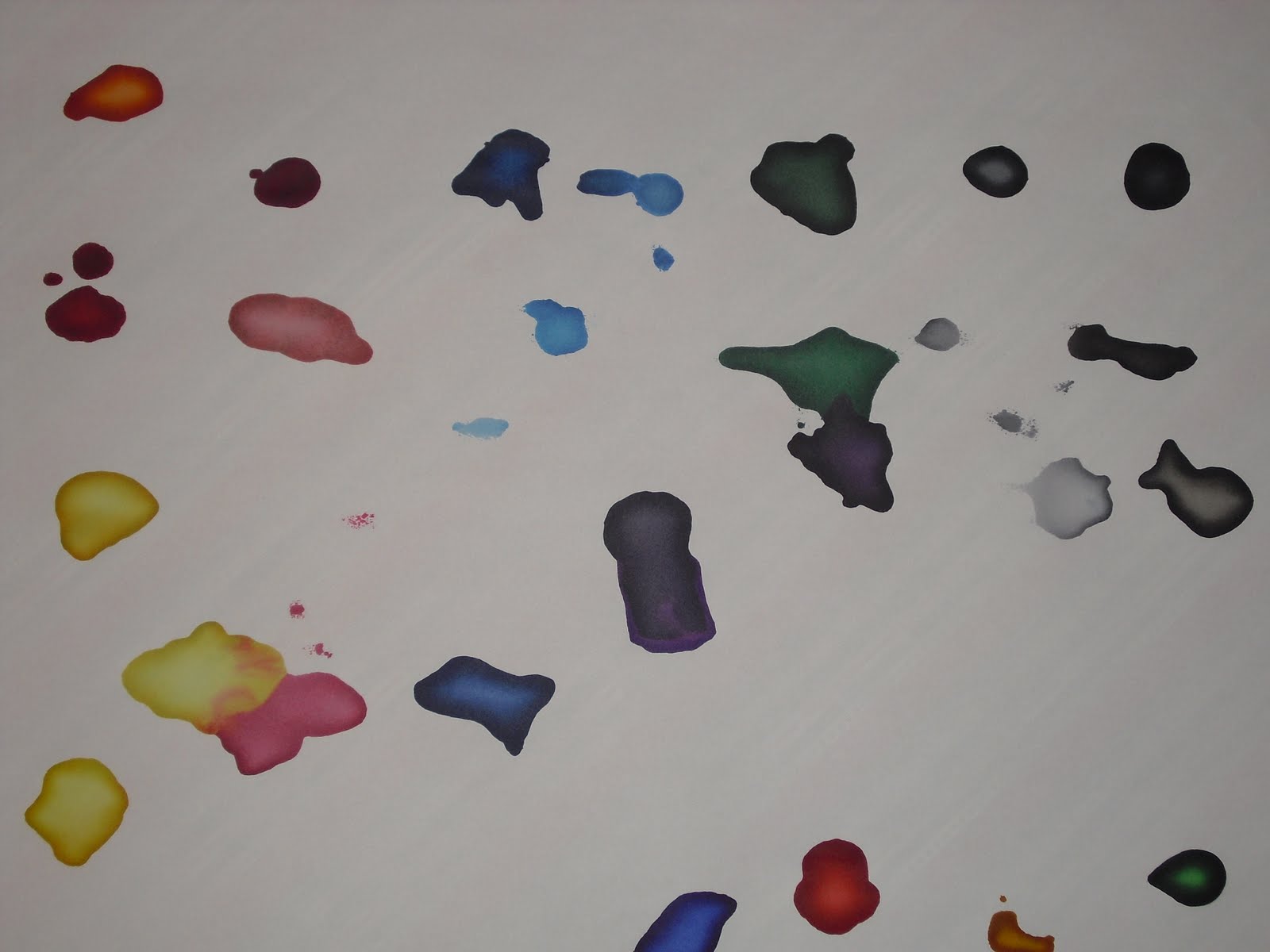
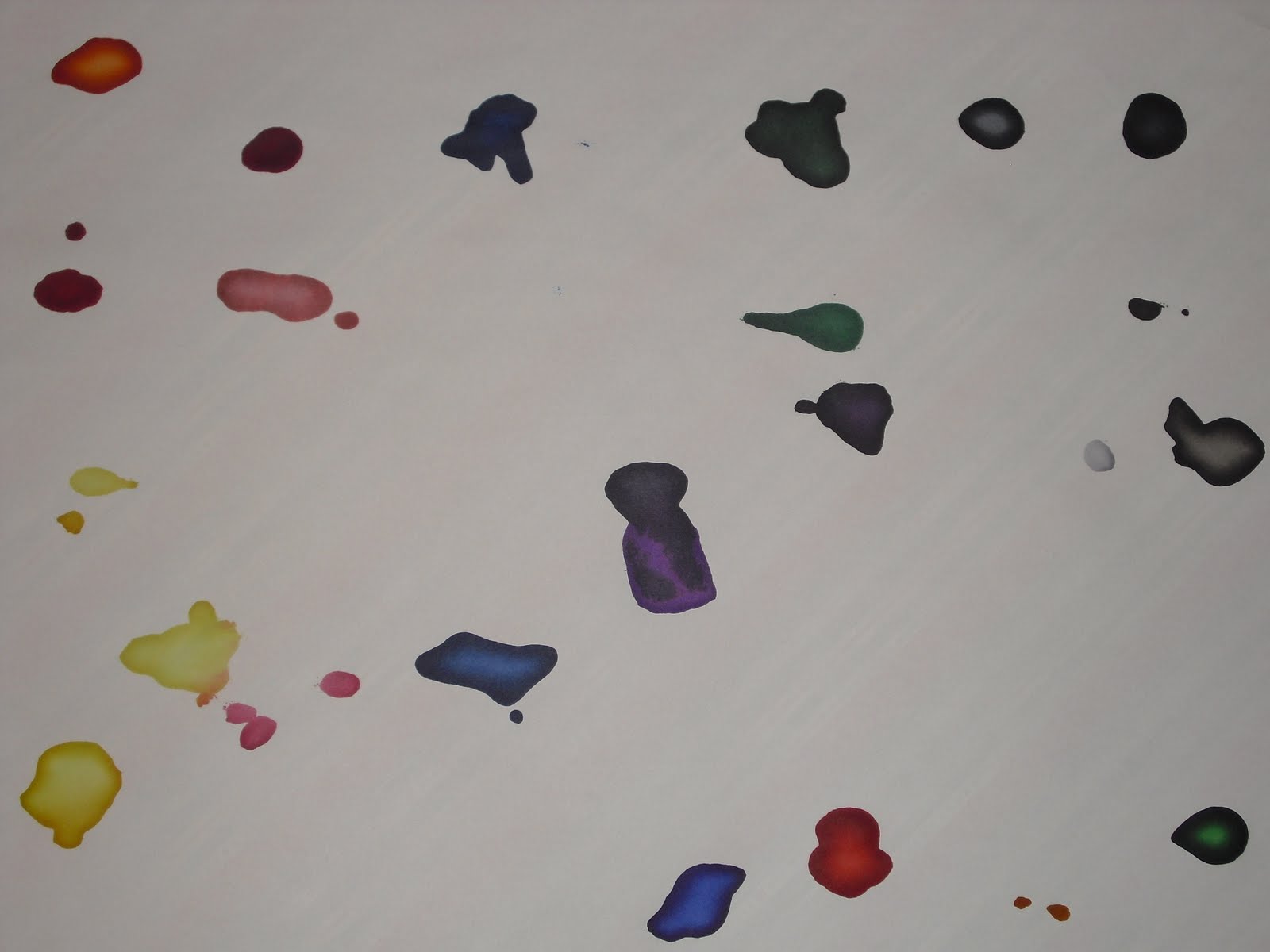
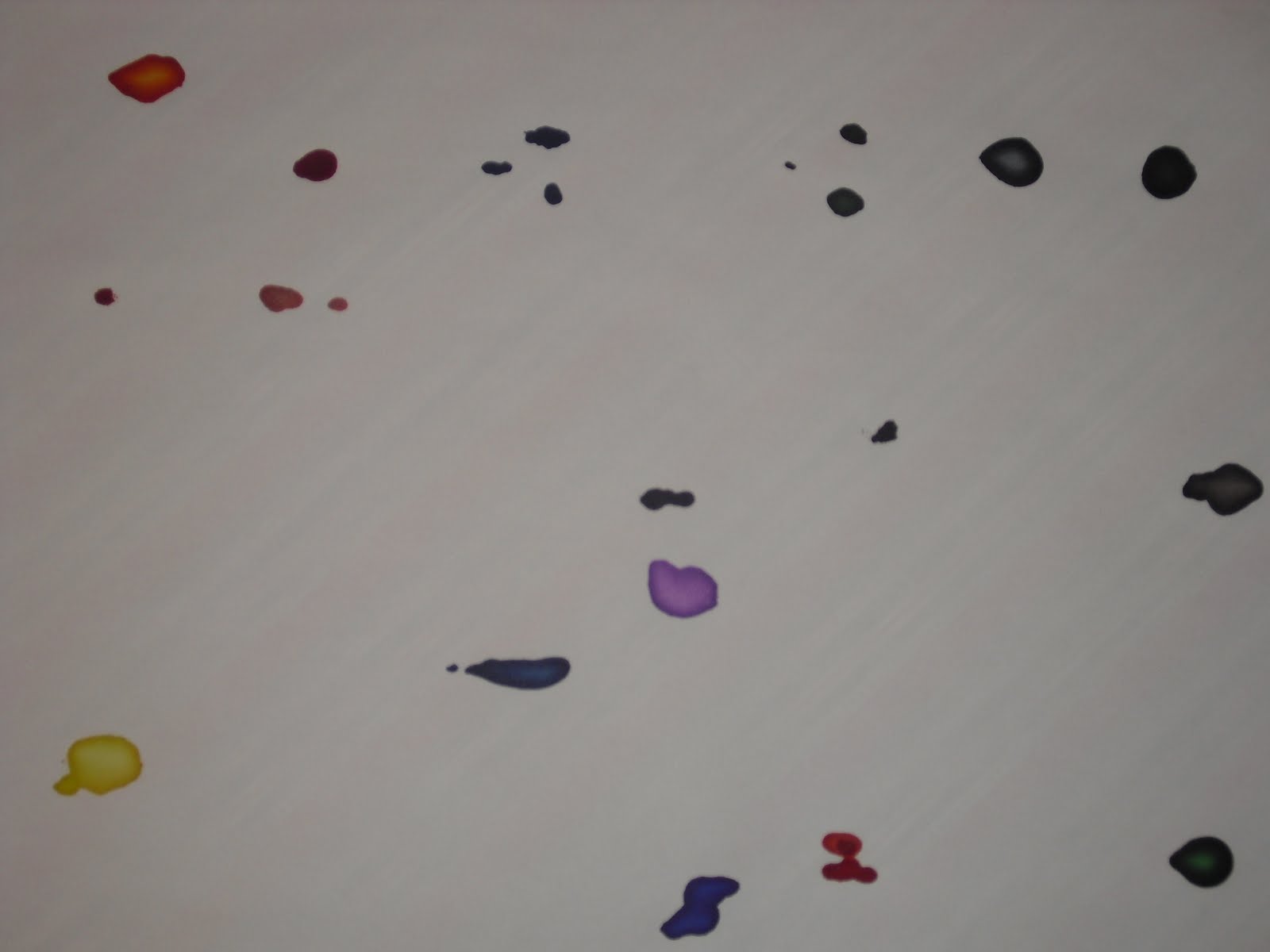
One month ago to the day four days from now I started an artistic endeavor having stationary markers soak through a stack of paper. I stood a set of Copic markers inside drinking glasses and waited. The neatly arranged set lived under a travertine coffee table in the auxiliary living room of my apartment. No more than 6 times did I accidentally disturb the glasses while I was sitting at the table drinking a bottle of wine.
Last night I revealed the sheets.
59.
The ink soaked through 59, 80gsm sheets of paper in one month. I was enjoying a bottle of Bordeaux last night and revealing each sheet one at a time. It told a story that I did not expect. As you moved the pages there would be a pint where one color would just disappear. Other colors expanded out, seemingly annexing other space and absorbing weaker colors. From page 12 to page 13 a half inch band of ice blue disappeared out of existence. I don’t know where it.
Vermillion.
Vermillion soaked through 59 sheets. I don’t know what gives Vermillion such persistence. It was quite the unexpected character trait. I expected Special Black 100 or Royal Blue 29 to penetrate the most. Or perhaps an intense purple. Sheet 59 had a pin dot of color in the upper left quadrant of the paper. On Sheet 1, vermillion did not soak and expand to the entire glass, the pigment focused into a dollop the size of a quarter.
Tomorrow I am going to take pictures and document all of the pieces with a proper camera. I’m also going to setup some triptychs and collections for those who are interested. Potential collections to include Prime Numbers, Even Numbers, my favorite numbers, your favorite numbers.

Last night I revealed the sheets.
59.
The ink soaked through 59, 80gsm sheets of paper in one month. I was enjoying a bottle of Bordeaux last night and revealing each sheet one at a time. It told a story that I did not expect. As you moved the pages there would be a pint where one color would just disappear. Other colors expanded out, seemingly annexing other space and absorbing weaker colors. From page 12 to page 13 a half inch band of ice blue disappeared out of existence. I don’t know where it.
Vermillion.
Vermillion soaked through 59 sheets. I don’t know what gives Vermillion such persistence. It was quite the unexpected character trait. I expected Special Black 100 or Royal Blue 29 to penetrate the most. Or perhaps an intense purple. Sheet 59 had a pin dot of color in the upper left quadrant of the paper. On Sheet 1, vermillion did not soak and expand to the entire glass, the pigment focused into a dollop the size of a quarter.
Tomorrow I am going to take pictures and document all of the pieces with a proper camera. I’m also going to setup some triptychs and collections for those who are interested. Potential collections to include Prime Numbers, Even Numbers, my favorite numbers, your favorite numbers.

Friday, November 26, 2010
Bored-eaux, Scarf events
I love Bordeaux. I would even venture to say that I subsist on Bordeaux1. However, the ever increasing prices are deeply troubling me. The finite number of barrels combined with the ever peaking demand is not working in my favor. I have thought about purchasing Bordeaux futures lately. By all accounts it could very well be a good investment and I could preemptively purchase the Bordeaux I no doubt want to consume. Conceivably I could even by enough Bordeaux to satisfy my personal demand and sell the remainder.
The pricing of Bordeaux all begins during the en primeur season of France, occurring annually in early April. The en primeur season is quite the event2 for oenophiles. Wine merchants and renowned experts taste young Bordeaux that have yet to be bottled, and in many cases have just finished fermenting5. The marks and criticism bestowed by Robert Parker and the like of the wine community regarding a wine that will undoubtedly change complexion and fortitude during the remaining time in the barrel of course has sweeping changes in the financial markets.
The volume of Bordeaux being exported to China has increased nearly 400% over the last decade with the prices following suit. Last year, China passed the U.S. to become Bordeaux's largest non-European export market. The demand for red wine in China, Bordeaux in particular, has transcended the perfunctory bottle with dinner and is an irrefutable symbol of status.

So, thanks China.
Really, thank you for this demand-pull inflation. Collateralized Bordeaux Obligations (CBO) are going through the proverbial chateaux roof and a metaphorical and literal bubble seems to be developing. While many wines are increasing in value nearly 40% have decreased in value from their en primeur pricing. While the speculation is not only with the quality of that year’s harvest, the speculation is also on the quality of the harvest for the next few years. New superior vintages of the substitute good could appear and dramatically drive down the prices. Besides Bordeaux as wines from other regions develop and sell at a lower price the value over the replacement option decreases and pushes down the price of Bordeaux to a rational equilibrium.
And now here are some lines from my upcoming novel:
Have you seen Steven lately?
--Not recently, how is his export business?
I can’t believe how ostentatious he is. He always unbuttons the last button on the cuff of his suit jacket. I can’t stand it.
--I don’t care for that one bit.
It’s quite troubling really.
1 I subsist on Bordeaux.
2 When Tom Baker, the fourth incarnation of Dr. Who3, was cast costume designer “James Acheson picked up a load of wool and asked a knitter called Begonia Pope to knit a scarf for Tom. She inadvertently used all the wool Acheson had given her, resulting in a scarf that was some twenty feet long.” While enjoying the internet I came upon a website4 that details the history of Baker’s signature scarf as well as detailed instructions on how to create your own. The website lists the notable scarf events to knit the scarf. I desperately hope scarf event is the proper term for a set of scarf instructions. I do not have the faculty to create such scarf.
3 The producer who had the idea that the Doctor suddenly had to change forms just every so often, or when there was probably a contract dispute, was brilliant. I think we can all agree that David Tennant was an awesome Doctor.
4 http://www.doctorwhoscarf.com/index.php
5 I made a barrel of wine with two of my friends one summer. We did it in my basement, which ultimately led to our downfall as we did not account for the effect the decreased temperature has on the time it takes proper fermentation to occur. We also kept dropping things into the barrel and had to fish them out with our hands.
The pricing of Bordeaux all begins during the en primeur season of France, occurring annually in early April. The en primeur season is quite the event2 for oenophiles. Wine merchants and renowned experts taste young Bordeaux that have yet to be bottled, and in many cases have just finished fermenting5. The marks and criticism bestowed by Robert Parker and the like of the wine community regarding a wine that will undoubtedly change complexion and fortitude during the remaining time in the barrel of course has sweeping changes in the financial markets.
The volume of Bordeaux being exported to China has increased nearly 400% over the last decade with the prices following suit. Last year, China passed the U.S. to become Bordeaux's largest non-European export market. The demand for red wine in China, Bordeaux in particular, has transcended the perfunctory bottle with dinner and is an irrefutable symbol of status.

So, thanks China.
Really, thank you for this demand-pull inflation. Collateralized Bordeaux Obligations (CBO) are going through the proverbial chateaux roof and a metaphorical and literal bubble seems to be developing. While many wines are increasing in value nearly 40% have decreased in value from their en primeur pricing. While the speculation is not only with the quality of that year’s harvest, the speculation is also on the quality of the harvest for the next few years. New superior vintages of the substitute good could appear and dramatically drive down the prices. Besides Bordeaux as wines from other regions develop and sell at a lower price the value over the replacement option decreases and pushes down the price of Bordeaux to a rational equilibrium.
And now here are some lines from my upcoming novel:
Have you seen Steven lately?
--Not recently, how is his export business?
I can’t believe how ostentatious he is. He always unbuttons the last button on the cuff of his suit jacket. I can’t stand it.
--I don’t care for that one bit.
It’s quite troubling really.
1 I subsist on Bordeaux.
2 When Tom Baker, the fourth incarnation of Dr. Who3, was cast costume designer “James Acheson picked up a load of wool and asked a knitter called Begonia Pope to knit a scarf for Tom. She inadvertently used all the wool Acheson had given her, resulting in a scarf that was some twenty feet long.” While enjoying the internet I came upon a website4 that details the history of Baker’s signature scarf as well as detailed instructions on how to create your own. The website lists the notable scarf events to knit the scarf. I desperately hope scarf event is the proper term for a set of scarf instructions. I do not have the faculty to create such scarf.
3 The producer who had the idea that the Doctor suddenly had to change forms just every so often, or when there was probably a contract dispute, was brilliant. I think we can all agree that David Tennant was an awesome Doctor.
4 http://www.doctorwhoscarf.com/index.php
5 I made a barrel of wine with two of my friends one summer. We did it in my basement, which ultimately led to our downfall as we did not account for the effect the decreased temperature has on the time it takes proper fermentation to occur. We also kept dropping things into the barrel and had to fish them out with our hands.
Monday, November 22, 2010
Excellent British shows vs. their terrible American counterparts
Yes, America dictates culture around the world. I know.
Why is it then, that the British invent so many awesome shows, which are then co-opted and bastardized by us, America, the kings of culture? Let's talk about a few examples: Ramsey's Kitchen Nightmares, Top Gear, and Skins.
Ramsey's Kitchen Nightmares (UK) gives us an intense fascinating look at fledgling restaurants around the Great Britain (and one British-owned restaurant in Spain). It follows Gordon Ramsey, a successful, hard-nosed, no bullshit chef who clearly possesses both great culinary skills and a fair amount of business acumen. He goes into a restaurant, gives it an evaluation, yells at the chef and the staff, helps them fix the menu, fixes the personnel-based issues, creates a marketing plan to drum up business, enacts said plan, then checks in at a later unspecified date to see how the restaurant is doing. This is all punctuated by Gordon getting flustered, quick interludes of staff confessionals, and Gordon's voice over saying how worried he is. It's a bit formulaic, but it's relatively cheap to produce, engaging, and it appears that the restaurants genuinely do benefit from the expert guidance. I thoroughly enjoy it.
Kitchen Nightmares (US) on the other hand, is a terrible show. For one, Ramsey's gotten either a lot wealthier or a lot more famous. But now whenever anyone mentions him on camera, they have to refer to him as Chef Ramsey. That's pretty douche-y. Secondly, because Americans are inherently much stupider than our British counterparts, we need a narrator (not Gordon) to tell us what is going on throughout the show. ("It's forty-five minutes into service and the kitchen is unable to cope with the new menu.") Also, as a condition of being on the show, we're basically guaranteed to see whatever restaurant it is get totally remade overnight by "Chef Ramsey's Team". Frankly this is unacceptable. Very infrequently did Gordon change the decor in the UK version, and when a change was made, it was the restaurant staff--and Ramsey--doing the work themselves. There also seems to be no interest in getting the restaurant to pull together as a cohesive unit, as compared to the UK version. If I had to sum up the American Kitchen Nightmares in a sentence it would be: Gordon Ramsey goes into a restaurant, tells them they suck, they disagree, he makes a new menu, they balk, he forces the issue, the restaurant gets totally redone overnight, the announcer announces the "grand relaunch", the restaurant flounders, Gordon yells, the owner yells, they try again and it gets better, Gordon calls the project a success and walks away. Similar to the UK version but with some key differences. Key stylistic differences that make the show terrible.
I'll be brief on the other two. Top Gear UK (heretoforth known simply as Top Gear) is a hilarious show where there are the three goofy (yet clever) older presenters who do ridiculous shenanigans in cars and also happen to do a very good job reviewing these amazingly expensive and rare supercars. They're also excellent drivers. It's a beautifully done show, from the score, to the cinematography to how they portray the vehicles.
From the five minutes I watched of Top Gear US, it's a fat guy who tries to be funny and fails, and a skinny guy who is utterly humorless. Not only that but the segment I saw was almost a direct rip-off of the real Top Gear, just much more poorly done. It was way too contrived, too choreographed, too obviously fake. Not only that but the car they were in was a Dodge Viper. Yes, it's a $90,000 car, but this was the premier episode and that's what they're leading with? I wouldn't exactly call it a supercar. It just doesn't have the appeal of Bugatti Veyron or a Konigsegg anything. I had no choice, I couldn't take it anymore. I had to turn it off. The fact that Top Gear US plays on the History Channel probably doesn't help.
Skins US isn't even out yet but it's going to be terrible. I'm not even going to go into it. Just click on over to We Knew the MTV Version of Skins was Going to Suck, but not this Much (courtesy of Gawker).
Why is it then, that the British invent so many awesome shows, which are then co-opted and bastardized by us, America, the kings of culture? Let's talk about a few examples: Ramsey's Kitchen Nightmares, Top Gear, and Skins.
Ramsey's Kitchen Nightmares (UK) gives us an intense fascinating look at fledgling restaurants around the Great Britain (and one British-owned restaurant in Spain). It follows Gordon Ramsey, a successful, hard-nosed, no bullshit chef who clearly possesses both great culinary skills and a fair amount of business acumen. He goes into a restaurant, gives it an evaluation, yells at the chef and the staff, helps them fix the menu, fixes the personnel-based issues, creates a marketing plan to drum up business, enacts said plan, then checks in at a later unspecified date to see how the restaurant is doing. This is all punctuated by Gordon getting flustered, quick interludes of staff confessionals, and Gordon's voice over saying how worried he is. It's a bit formulaic, but it's relatively cheap to produce, engaging, and it appears that the restaurants genuinely do benefit from the expert guidance. I thoroughly enjoy it.
Kitchen Nightmares (US) on the other hand, is a terrible show. For one, Ramsey's gotten either a lot wealthier or a lot more famous. But now whenever anyone mentions him on camera, they have to refer to him as Chef Ramsey. That's pretty douche-y. Secondly, because Americans are inherently much stupider than our British counterparts, we need a narrator (not Gordon) to tell us what is going on throughout the show. ("It's forty-five minutes into service and the kitchen is unable to cope with the new menu.") Also, as a condition of being on the show, we're basically guaranteed to see whatever restaurant it is get totally remade overnight by "Chef Ramsey's Team". Frankly this is unacceptable. Very infrequently did Gordon change the decor in the UK version, and when a change was made, it was the restaurant staff--and Ramsey--doing the work themselves. There also seems to be no interest in getting the restaurant to pull together as a cohesive unit, as compared to the UK version. If I had to sum up the American Kitchen Nightmares in a sentence it would be: Gordon Ramsey goes into a restaurant, tells them they suck, they disagree, he makes a new menu, they balk, he forces the issue, the restaurant gets totally redone overnight, the announcer announces the "grand relaunch", the restaurant flounders, Gordon yells, the owner yells, they try again and it gets better, Gordon calls the project a success and walks away. Similar to the UK version but with some key differences. Key stylistic differences that make the show terrible.
I'll be brief on the other two. Top Gear UK (heretoforth known simply as Top Gear) is a hilarious show where there are the three goofy (yet clever) older presenters who do ridiculous shenanigans in cars and also happen to do a very good job reviewing these amazingly expensive and rare supercars. They're also excellent drivers. It's a beautifully done show, from the score, to the cinematography to how they portray the vehicles.
From the five minutes I watched of Top Gear US, it's a fat guy who tries to be funny and fails, and a skinny guy who is utterly humorless. Not only that but the segment I saw was almost a direct rip-off of the real Top Gear, just much more poorly done. It was way too contrived, too choreographed, too obviously fake. Not only that but the car they were in was a Dodge Viper. Yes, it's a $90,000 car, but this was the premier episode and that's what they're leading with? I wouldn't exactly call it a supercar. It just doesn't have the appeal of Bugatti Veyron or a Konigsegg anything. I had no choice, I couldn't take it anymore. I had to turn it off. The fact that Top Gear US plays on the History Channel probably doesn't help.
Skins US isn't even out yet but it's going to be terrible. I'm not even going to go into it. Just click on over to We Knew the MTV Version of Skins was Going to Suck, but not this Much (courtesy of Gawker).
Wednesday, November 17, 2010
The Bad Decision Index
Everyone has some sort of barometer for determining when a night may have gotten out of control, when you maybe should have called it a night and not tried to hit on the police officer to avoid a night in the drunk tank. My metric is entirely fact based and documented, as it turns out, courtesy of transaction tags from American Express.
In case you're not familiar, the lovely people at American Express break down your charges into various categories like transportation, groceries, dining out, entertainment, et al. so that you can better track your annual expenses. They also give you the option to add your own tags to transaction, so you can define what you spend in your terms. Of my many customized tags, the one I like to use least often is "Bad Decisions"
While your bad decision spectrum may put Stay Home and Play Checkers on one side and Try to Break Into the Organization of American States1 on the other, mine are generally viewed in terms of economic impact. You know why? Because sometimes, at 3:00am, it genuinely is a good idea to wander off into northern Virginia, and inform the gang that you are by a bunch of trees and please come get you2. Sometimes great things come of this.
Here's what I consider a bad decision. Buying an excruciating amount of shots, drinks, beers, and other consumables for me and my 50 closest friends at the bar. Because here's the thing, once you get the ball rolling, there's really no stopping it3. By the time the house lights come on, I'm the bartender's best friend, I've gotten us both drunk (the bartender too, most likely), and even with the fuzzy math that generally goes into calculation of my tab I'm still walking out the door for like $200. Was it a special occasion? Maybe, probably not. Generally it was a random Thursday night where somebody posed the seemingly innocuous question, "Shots?"
The amazing thing about my bad decision index is that it's largely independent of frequency, intensity, and scope. I've had billing periods where I go out hard and billing periods where I try to restrain myself, and after the dust settles, the Bad Decision Meter is remarkably consistent. I can't explain it. I've almost come to view it as a fixed cost.
The one strangely constant thing is that the legibility of the handwriting on my copy of the receipt (I always manage to take it) is inversely proportional to the percentage tip I leave.
Is this rational? Does this make sense? Of course not. But I have come to terms that one of my base instincts is the desire to make my friends happy. And as it turns out, when I'm drunk, making you happy is performed by getting us both drunker.
Until tomorrow, I leave you with this pearl of wisdom:
A man, a plan, a canal, Panama!4
1 You know who you are.
2 Same guy
3

4 It's a palindrome5, stupid.
5 Have you ever wondered why palindrome isn't a palindrome? So many other literary devices intimate their definition in the pronunciation, like onomatopoeia or alliteration.
In case you're not familiar, the lovely people at American Express break down your charges into various categories like transportation, groceries, dining out, entertainment, et al. so that you can better track your annual expenses. They also give you the option to add your own tags to transaction, so you can define what you spend in your terms. Of my many customized tags, the one I like to use least often is "Bad Decisions"
While your bad decision spectrum may put Stay Home and Play Checkers on one side and Try to Break Into the Organization of American States1 on the other, mine are generally viewed in terms of economic impact. You know why? Because sometimes, at 3:00am, it genuinely is a good idea to wander off into northern Virginia, and inform the gang that you are by a bunch of trees and please come get you2. Sometimes great things come of this.
Here's what I consider a bad decision. Buying an excruciating amount of shots, drinks, beers, and other consumables for me and my 50 closest friends at the bar. Because here's the thing, once you get the ball rolling, there's really no stopping it3. By the time the house lights come on, I'm the bartender's best friend, I've gotten us both drunk (the bartender too, most likely), and even with the fuzzy math that generally goes into calculation of my tab I'm still walking out the door for like $200. Was it a special occasion? Maybe, probably not. Generally it was a random Thursday night where somebody posed the seemingly innocuous question, "Shots?"
The amazing thing about my bad decision index is that it's largely independent of frequency, intensity, and scope. I've had billing periods where I go out hard and billing periods where I try to restrain myself, and after the dust settles, the Bad Decision Meter is remarkably consistent. I can't explain it. I've almost come to view it as a fixed cost.
The one strangely constant thing is that the legibility of the handwriting on my copy of the receipt (I always manage to take it) is inversely proportional to the percentage tip I leave.
Is this rational? Does this make sense? Of course not. But I have come to terms that one of my base instincts is the desire to make my friends happy. And as it turns out, when I'm drunk, making you happy is performed by getting us both drunker.
Until tomorrow, I leave you with this pearl of wisdom:
A man, a plan, a canal, Panama!4
1 You know who you are.
2 Same guy
3
4 It's a palindrome5, stupid.
5 Have you ever wondered why palindrome isn't a palindrome? So many other literary devices intimate their definition in the pronunciation, like onomatopoeia or alliteration.
Tuesday, November 16, 2010
The Preamble
Today we begin an experiment in humanity. Today, you and I together will step out to the edge. We will push the envelope. Today marks Day One of an imposed sobriety, and I'm taking you with me.
The Buildup
I like to drink. I like to drink because it's a social lubricant, because it's entertaining. People tend to smile more after a drink, and as a direct result, my level of wit and intrigue increases. The subtle craftsmanship of spirits, the descriptors, textures, and aromas. The hunt for the perfect cocktail. I don't discriminate. I'll talk politics over the nicest bourbon you can find then wander into a dive bar and throw back a Pabst Blue Ribbon and a shot of Jameson. The sauce, my friend, is how you make connections.
Think about how many fewer people you'd know if you didn't drink. How many fewer stories you'd have. Don't believe me? Take a night off, walk into any neighborhood bar by yourself and just sit down and have a few drinks. People will just approach you to chat, to hear your story. It might start with the bartender, but then you'll drag in the person next to you, and then a few more. The next night, go to a library. It just doesn't work. Some of the coolest, most fascinating people I've ever met have been randomly sitting next to me at a bar. Quite simply, society favors drink.
Now I'm not advocating blacking out seven nights a week, and I don't suggest getting drunk all the time. But there is something deeply satisfying and refreshing about having a drink or two.
So what's this going to be like? I predict my creativity will be deeply affected. I'm basing this solely on how successful other highly intoxicated people have been. Like Ernest Hemingway, F. Scott Fitzgerald, Edgar Allen Poe, Kingsley Amis, or Werner von Braun. I'm not going to go to sleep any earlier, though I'll probably eat a lot better. I don't know why.
Obviously the one area that my imposed sobriety won't affect is work. Because that's boring and neither of us care, let's move on.
So, Day One: I went to work two hours late. It was scheduled and awesome. Downside: Financial Times was long gone. There has been a lot of Arcade Fire going on in my head today.
Tomorrow I'm going to come up with a machine that can do my job. I don't think it should be that difficult. I imagine it's going to be a mix between a gigantic Scantron machine and one of those punch-card computers from the 60's. Actually it's going to look like this:
 Except that instead of the person, it would just be another (admittedly retro looking) computer. Or maybe a paperwork receiving area.
But at the end of the day, there's something to be said about getting off work, downing several shots, a few beers, half a bottle of wine, and then going to dinner. More tomorrow.
The Buildup
I like to drink. I like to drink because it's a social lubricant, because it's entertaining. People tend to smile more after a drink, and as a direct result, my level of wit and intrigue increases. The subtle craftsmanship of spirits, the descriptors, textures, and aromas. The hunt for the perfect cocktail. I don't discriminate. I'll talk politics over the nicest bourbon you can find then wander into a dive bar and throw back a Pabst Blue Ribbon and a shot of Jameson. The sauce, my friend, is how you make connections.
Think about how many fewer people you'd know if you didn't drink. How many fewer stories you'd have. Don't believe me? Take a night off, walk into any neighborhood bar by yourself and just sit down and have a few drinks. People will just approach you to chat, to hear your story. It might start with the bartender, but then you'll drag in the person next to you, and then a few more. The next night, go to a library. It just doesn't work. Some of the coolest, most fascinating people I've ever met have been randomly sitting next to me at a bar. Quite simply, society favors drink.
Now I'm not advocating blacking out seven nights a week, and I don't suggest getting drunk all the time. But there is something deeply satisfying and refreshing about having a drink or two.
So what's this going to be like? I predict my creativity will be deeply affected. I'm basing this solely on how successful other highly intoxicated people have been. Like Ernest Hemingway, F. Scott Fitzgerald, Edgar Allen Poe, Kingsley Amis, or Werner von Braun. I'm not going to go to sleep any earlier, though I'll probably eat a lot better. I don't know why.
Obviously the one area that my imposed sobriety won't affect is work. Because that's boring and neither of us care, let's move on.
So, Day One: I went to work two hours late. It was scheduled and awesome. Downside: Financial Times was long gone. There has been a lot of Arcade Fire going on in my head today.
Tomorrow I'm going to come up with a machine that can do my job. I don't think it should be that difficult. I imagine it's going to be a mix between a gigantic Scantron machine and one of those punch-card computers from the 60's. Actually it's going to look like this:
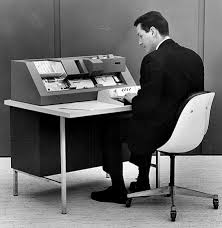 Except that instead of the person, it would just be another (admittedly retro looking) computer. Or maybe a paperwork receiving area.
But at the end of the day, there's something to be said about getting off work, downing several shots, a few beers, half a bottle of wine, and then going to dinner. More tomorrow.
Subscribe to:
Posts (Atom)